
A different kind of conversation about mental health
There is a line I came across while studying behavioural assessment that stopped me mid-read:
“Rather than merely controlling or suppressing undesirable symptoms, the ultimate objective is actively focused on developing positive, adaptive behaviours.”
It is not a complicated sentence. But it reframed something I had been sensing for a while without quite being able to name it.
The Story We Tell About Therapy
Spend any time on social media, and a particular narrative about mental health and healing dominates.
Someone shares how years of therapy helped them trace their anxiety back to a moment in childhood. Another person describes the breakthrough of realising how a parent’s emotional unavailability shaped their adult relationships. A third talks about finally understanding why they self-sabotage and it leads back, again, to something that happened long ago.
These stories are real. They are valid. Insight into the past genuinely does help. Psychodynamic and trauma-informed approaches have changed lives, and there is rigorous evidence behind them.
But they occupy so much of the popular imagination around healing that they can create an unspoken assumption: that the primary work of psychological recovery is archaeological ( digging back, unearthing, understanding).
What happens when that framing becomes the only one people know?
The Problem With Only Looking Back
There is something subtly disempowering about a framework in which the explanation for your present always lives in your past.
Not because it is untrue. But because it can quietly shift the locus of change to something you cannot touch; events that have already happened, people who may never change, wounds that may never fully close.
It also means that success tends to be defined in the negative: fewer symptoms. Less anxiety. Reduced avoidance. Diminished reactivity.
These are meaningful goals. But they describe an absence and of the removal of something unwanted. They do not describe a life being built.
A Different Orientation
The line from my coursework points toward something else entirely.
Instead of asking “what went wrong, and how do I stop it from happening again?”, it invites the question: “what do I want to build, and what behaviours will take me there?”
This is not a rejection of the past. It is a shift in where energy is directed.
Approaches like Positive Psychology, Behaviour Activation, and Acceptance and Commitment Therapy (ACT) share this forward-facing orientation. Rather than spending the bulk of therapeutic effort on dismantling old patterns, they ask: What kind of person do you want to be? What actions align with that? What does a valued, functional life look like for you and can we start moving toward it, even before you feel ready?
The insight is deceptively simple: you cannot think your way out of a behaviour. You act your way into a new one.
The Brain Agrees
Here is what makes this approach more than just philosophical optimism – neuroscience supports it.
The brain is not fixed. Through a property called neuroplasticity, it continuously reorganises itself in response to experience, thought, and behaviour. Every time we repeat an action, the neural pathways associated with it are reinforced, quite literally, the connections between neurons grow stronger. And every time we introduce a new behaviour consistently, the brain begins to lay down new circuitry to support it.
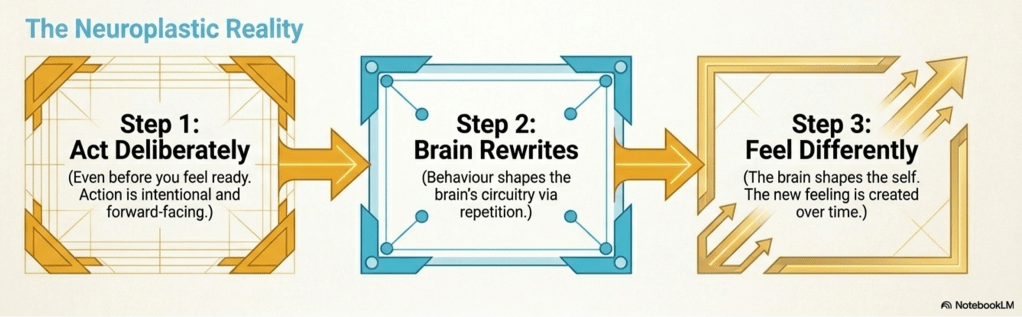
This is why suppression alone rarely works. Trying to not do something keeps your attention, and your neural energy, trained on the very thing you want to avoid. The old pathway stays active. But when you redirect toward building a new behaviour, you are doing something more powerful: you are giving the brain a different road to travel, and with repetition, that road becomes the familiar one.
What this means, practically, is that you do not have to wait until you feel different to act differently. The action itself, repeated, intentional, forward-facing, is what creates the feeling over time. Behaviour shapes the brain. The brain shapes the self. The sequence matters.
Try Shifting the Question
The most immediate way to apply this is simply to notice the questions you ask yourself when you are stuck and gently reframe them.
Instead of asking “Why do I keep binge eating?” → ask “What am I actually hungry for in this moment, and what else could meet that need?”
Instead of “Why am I so anxious all the time?” → ask “What is one small thing I would do today if I were not afraid and can I do just that?”
Instead of “Why can’t I stop scrolling at night?” → ask “What kind of evening routine would make me feel rested and in control and what is the first step toward it?”
Instead of “Why do I always avoid difficult conversations?” → ask “What would it look like to be the kind of person who speaks honestly and what is the least threatening version of that I could try today?”
Notice the shift. The first question looks for an explanation. The second looks for a direction. Both have value but only one of them gives you somewhere to go.
Why This Shift Matters
There is something quietly hopeful about a model that says: regardless of what happened, you can build something new. It does not dismiss your history. But it does not hold you hostage to it either. It moves the conversation from deficit to development and from what is broken to what is possible. From the symptom to the life being built around and beyond it.
For anyone navigating a difficult habit, a period of anxiety, a bout of depression, or simply a version of themselves they no longer recognise. This reframe offers something worth sitting with:
Healing may not be about getting back to who you were before. It may be about deliberately building who you are becoming.


Leave a Reply