A few years into my corporate career, I sat across from an leadership consultant who had been hired to evaluate three leaders, myself included, for a deputy business head role that had come up. The outcome of that process was a report running into many pages about my leadership style. One of the components measured my natural style against my adapted style of leadership, and across many parameters, my adapted score was higher than my natural one.
I remember nodding along at the time, filing it under “useful feedback,” and moving on with my work. I didn’t care much at the time, since I got the promotion!
It was only recently that I went back to that report, after being introduced to Carl Rogers’ theory of personality during my coursework. The consultant’s natural and adapted turned out to be a corporate echo of something Rogers called, the Real Self and the Ideal Self.
Two Selves, Long Before Rogers Had a Name for Them
Carl Rogers, one of the founding figures of humanistic psychology, spent decades studying what makes people psychologically healthy rather than only what makes them unwell. Out of that work came a deceptively simple idea: each of us carries around two pictures of ourselves, not unlike the two scores that sat side by side in that report.
The Real Self and the Ideal Self
The Real Self is who you actually are: your present feelings, values, instincts, and behaviour, however unpolished or inconvenient they might be.
The Ideal Self is who you believe you should be: an image built up over years from what was praised, rewarded, punished, or quietly withdrawn by the people whose acceptance mattered to you.
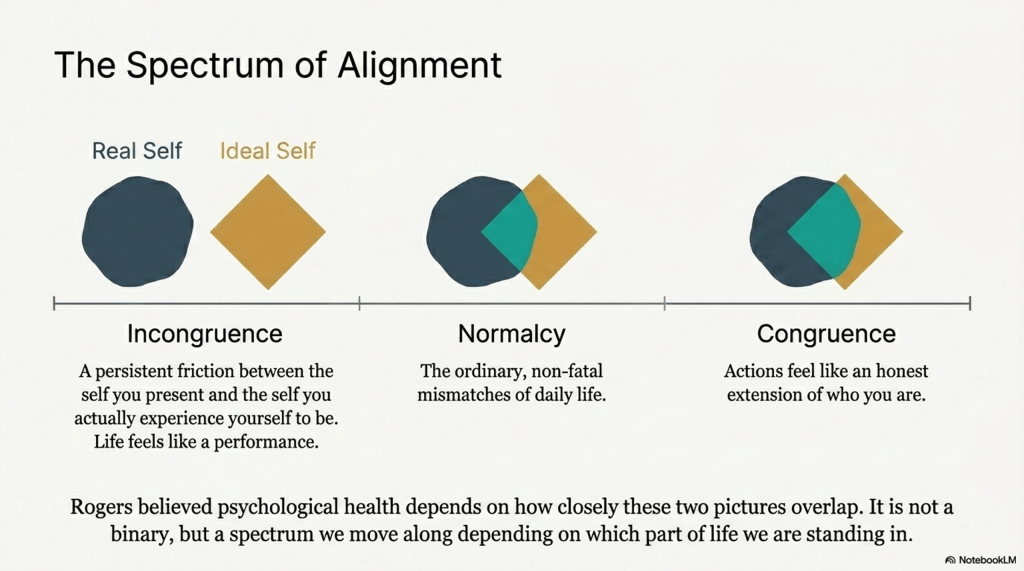
Rogers believed that psychological health depends largely on how closely these two pictures overlap.
When they’re close, he called it congruence, a state where your actions feel like an honest extension of who you are, rather than a performance of who you’re supposed to be.
When they’re far apart, he called it incongruence, a persistent friction between the self you present and the self you actually experience yourself to be.
This isn’t a binary. Nobody is in perfect congruence, and nobody is entirely incongruent. It’s a spectrum we move along, often without realising it, depending on which part of life we’re standing in.
Where the Ideal Self Comes From
If the Real Self is simply what is, the Ideal Self has to come from somewhere, and Rogers had a precise answer for where. He called it conditions of worth: the messages, spoken and unspoken, that teach us when we’re worthy of approval, love, acceptance, or respect.
A child who is affectionate and curious might also be strong-willed and questioning. She quickly learns that the first set is celebrated while the second is met with a sharp correction.
A teenager who notices that high-achieving professionals are admired at family gatherings while artists are politely dismissed may absorb the idea that some paths make a person more worthy than others.
A young employee praised every time he works late starts to quietly equate his worth with constant productivity.
A mother who only hears she’s a “good mother” on the days she’s sacrificed her own needs may, over time, lose the ability to even recognise her own exhaustion, because self-sacrifice has folded itself into her ideal.
None of these are dramatic events. That’s precisely what makes conditions of worth so effective, they rarely arrive as a single lesson. They arrive as a thousand small signals, repeated until the editing becomes automatic. The Ideal Self stops being about who we genuinely want to be and becomes, instead, about who we believe we must be to stay acceptable.
What Incongruence Actually Feels Like
Incongruence is what happens when that gap grows too wide, and we end up actually feeling disconnected from ourselves. A temporary mismatch between reality and self-image is ordinary and not, on its own, a problem. The trouble starts when incongruence stops being occasional and becomes a way of life.
Consider a manager who believes good leaders must always appear confident, who feels genuinely uncertain about a major decision. He suppresses it rather than admit it, projecting certainty outwardly while carrying anxiety inwardly. The gap between the two only widens with repetition.
Long-term incongruence doesn’t stay contained to mood or self-image, it tends to show up in the body and in the quality of a life, not just the feel of it.
Chronic self-monitoring, the constant calibration of how one is coming across, the energy spent maintaining a version of oneself that doesn’t have an “off” register, these draw on a kind of reserve that doesn’t show up on any performance review, until eventually it presents its own bill, often in the form of exhaustion, anxiety, or burnout that seems to arrive “out of nowhere.”
It rarely is out of nowhere. It’s usually the accumulated cost of a gap that was never named.
Congruence: When Life Feels Aligned
Rogers used the word congruence for a state where the Real Self and the Ideal Self are reasonably aligned — not perfectly, but without the constant low-level battle between experience and self-image.
Picture a teacher who values patience but occasionally loses her temper, and when it happens, simply acknowledges it: yes, I got frustrated, and that’s not how I want to respond, but it happened. Her self-concept is flexible enough to hold the imperfection without cracking.
Or an employee who realises he genuinely prefers meaningful work over status, and turns down a prestigious role that doesn’t fit him, despite the pressure to take it. His choice reflects what he actually values, not what he’s supposed to want.
Or picture a child who often ends up eating lunch alone, while the rest of his class clusters into groups across the playground. He simply holds what’s actually true: I don’t have many friends right now, and that’s hard sometimes, but it doesn’t mean something is wrong with me. Just an honest, undefended look at what’s actually happening, without the story running ahead of the facts.
Congruence tends to feel like authenticity, not because life becomes easier, but because so much less energy goes into pretending.
Moving Toward Congruence
Rogers didn’t think of congruence as a finish line, a point you reach and then stay at forever. He saw it more as a direction you keep walking in, and he pointed to a few things that tend to help.
In On Becoming a Person, he writes about coming to terms with being what he called a “decidedly imperfect person” — someone who doesn’t always function the way he’d like to — and from that, he draws what he calls a curious paradox: that real change tends to follow self-acceptance, not the other way around. As he put it, it’s only “when I accept myself just as I am, then I can change.”
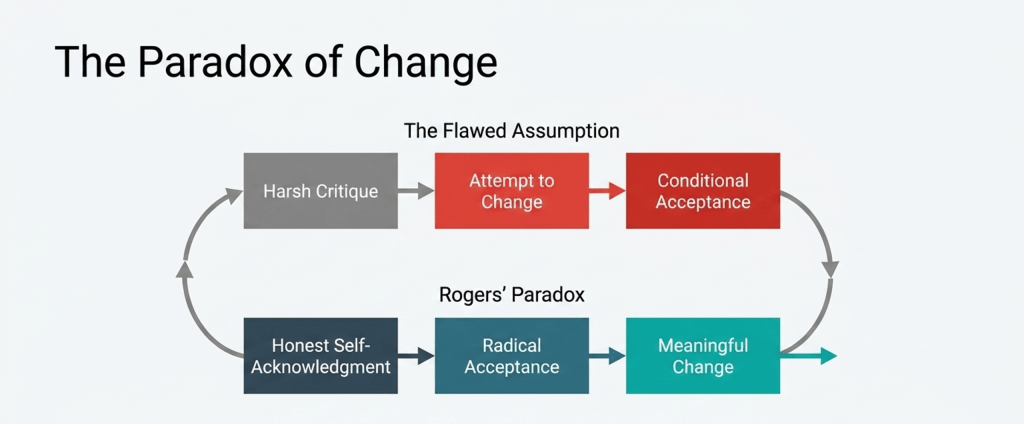
That kind of honest self-acknowledgment isn’t giving up, it’s usually the only thing that makes the next step possible, because it’s very hard to change something you’ve never let yourself look at clearly.
Rogers called the experience of being accepted without conditions as unconditional positive regard, and he believed we need to receive it from others first. But we don’t have to wait indefinitely for it. At some point, the work shifts to learning to extend that same acceptance inward because as long as we believe our worth has to be earned, there’s little incentive to stop performing and just be who we are.
Most of us aren’t struggling because we lack ambition. We’re struggling because we’ve grown attached to an image of who we think we’re supposed to be.
Perhaps psychological growth isn’t always about becoming someone new, but sometimes it’s simply about becoming less afraid of who we already are. And it’s in that space, between self-judgment and self-acceptance, that congruence begins to take shape — the same space, I suspect, that report had been quietly pointing me toward, years before I was ready to read it.


Leave a Reply