
Most of us have encountered Maslow’s pyramid at some point, physiological needs at the base, then safety, love and belonging, esteem, and finally self-actualisation at the top. We nod at it, like it, and move on.
But as I’ve sat with this theory as a psychology student, what caught my attention wasn’t the pyramid itself but it was something Maslow observed later in his work. He drew a deeper distinction between why we pursue the things we pursue.
Maslow divided human motivation into two fundamental categories.
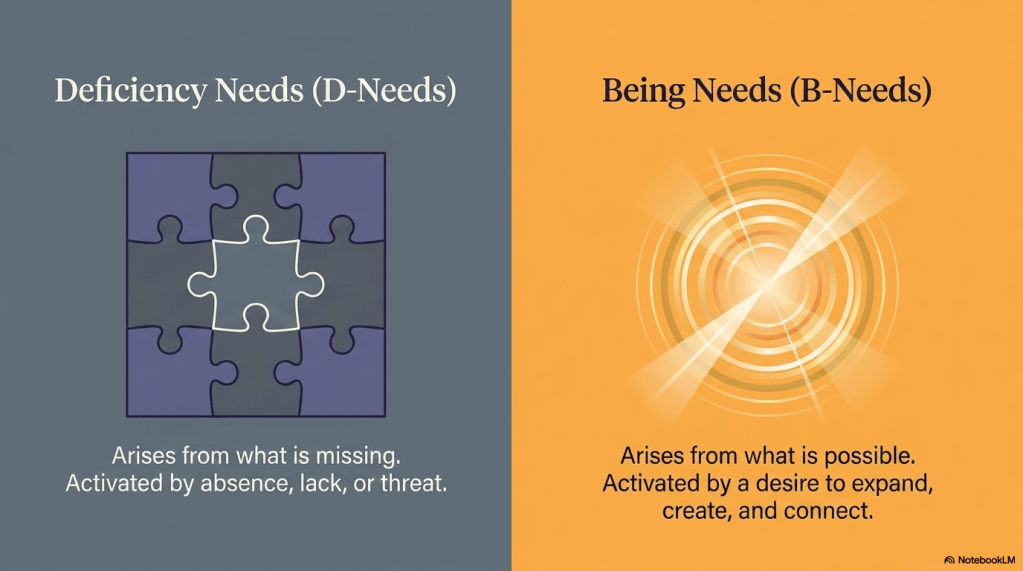
One arises from what is missing. The other from what is possible. He called them Deficiency Needs (D-Needs) and Being Needs (B-Needs).
Maslow developed this theory during World War II. He watched the violence, the fear, the fracturing of societies, and became convinced that psychology was spending too much time studying what goes wrong with people — and almost no time studying what goes right. So he did something unusual. He chose a set of people he believed had truly flourished — Abraham Lincoln, Albert Einstein, Eleanor Roosevelt, Harriet Tubman, among others — and studied their lives carefully, looking for what they had in common.
What he found wasn’t wealth, or status, or even happiness in the conventional sense. It was a particular quality of motivation. They weren’t striving to fill a hole. They were striving to expand. That observation became the foundation of his hierarchy — and of a distinction he considered the most important one in human psychology.
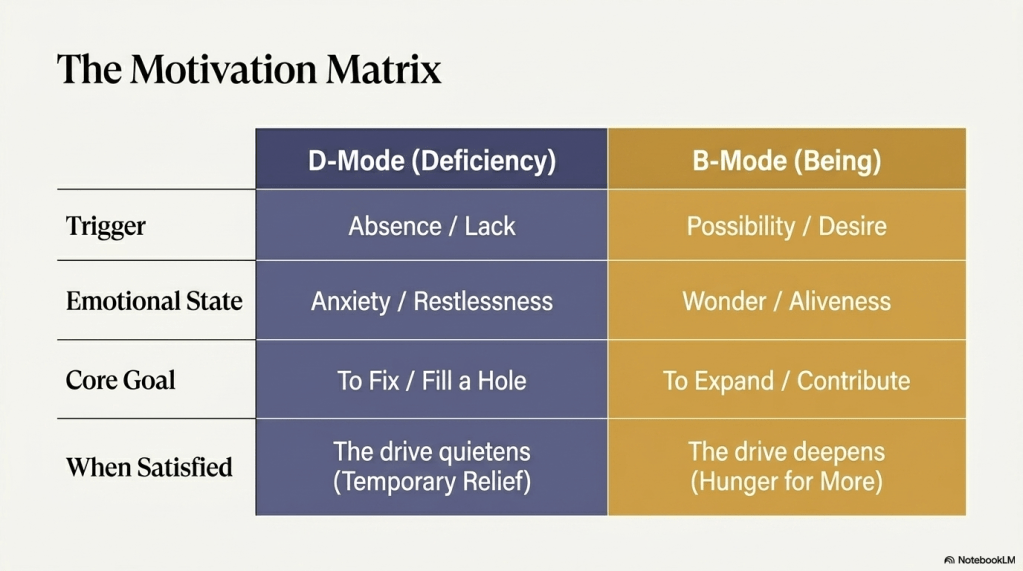
The more I think about them, the more I wonder how many of us spend years sometimes decades believing we’re growing, when we’re actually just solving one deficiency after another.
The Mode We Default To
Here is something Maslow observed that rarely makes it into the motivational posters: most people in modern societies have their basic physiological and safety needs met — and yet remain locked in D-mode for decades.
Why? Because the nervous system doesn’t know the difference between a tiger in the bush and a performance review. Between physical starvation and the fear of being left out. Between mortal danger and the quiet dread of not being enough.
Deficiency mode is not inherently negative. It helps us solve problems, reduce uncertainty, and create stability. The challenge is that it can quietly become our default operating system, keeping us focused on the next problem to solve rather than the life we’re trying to build.
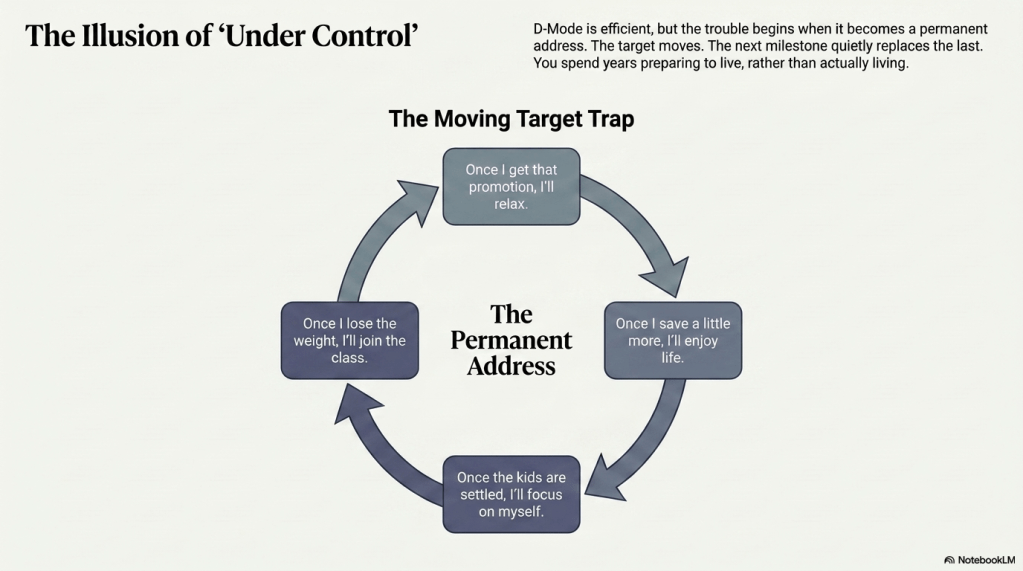
And somehow, everything is never quite under control. The target moves. The next issue appears. The next milestone quietly replaces the last. Years pass, and you’ve been busy — genuinely busy, genuinely responsible, genuinely productive — but when you look back, something feels oddly thin about it. Like you were always preparing to live rather than actually living.
The Sneaky Thing About D-Motivation
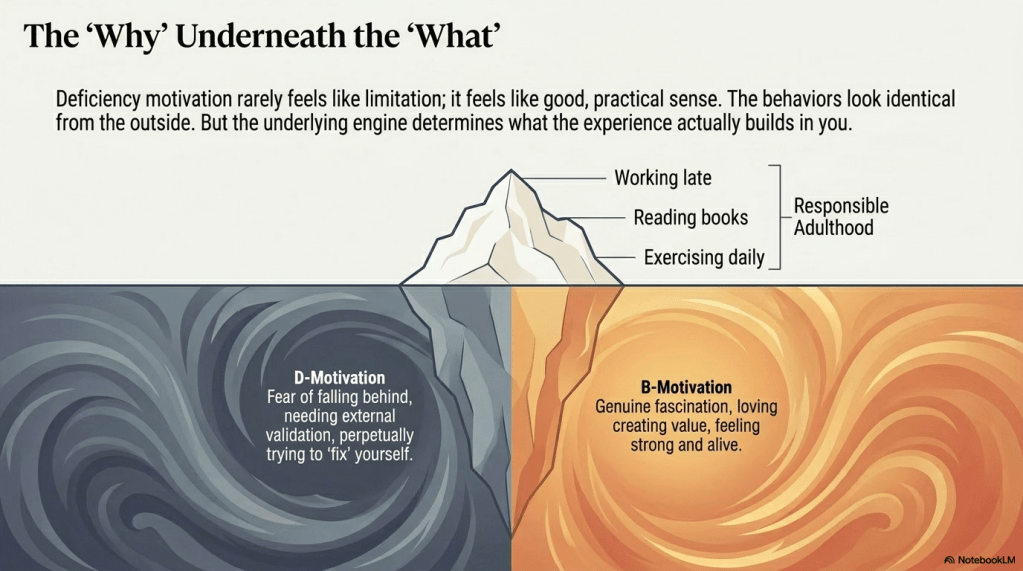
This is where it gets uncomfortable, because deficiency motivation rarely feels like limitation. More often, it feels like good sense. You’re being practical, planning ahead, preparing for the future, doing what capable adults are supposed to do.
But look more closely at the why underneath the what.
Are you reading because something genuinely fascinates you — or because you’re afraid of falling behind?
Are you working hard because you love creating something of value — or because external validation is the only thing that quiets the noise?
Are you exercising because you love feeling strong and alive — or because you’re perpetually trying to fix yourself?
The behaviours can look identical from the outside but the motivation running underneath them is completely different and it determines everything about how the experience actually feels, and what it actually builds in you.
What Growth Motivation Looks Like
Growth motivation begins when life is no longer organised around filling holes. It becomes organised around expansion — not because something is missing, but because something is possible.
A person operating from this place might learn a language simply because it opens a world that fascinates them.
Take up painting with no intention of ever selling anything.
Travel to genuinely inhabit a different way of seeing, not to accumulate destinations.
Start a project because it feels meaningful, independent of what it will do for their résumé.
Spend an afternoon going deep into something purely because it sparks wonder.
Notice what is absent from all of these: desperation. There is effort, discipline, even struggle — but underneath it runs something that feels more like aliveness than anxiety.
B-Needs, Maslow observed, have an unusual quality: unlike D-Needs, satisfying them doesn’t extinguish the drive. Understanding deepens curiosity. Genuine connection makes you hunger for more of it. The more you grow, the more you want to.
The Question That Changes Everything
Imagine two people walking into the same workshop.
One is there because they have long felt inadequate and are hoping this will finally be the thing that makes them enough. The other is there because they are already reasonably comfortable with themselves, and they simply want to go further. Same room, same content, same instructor — entirely different experience. One is trying to repair. The other is trying to expand. Maslow believed the second state is where self-actualisation begins to take root.
You Don’t Need a Perfect Life to Enter Growth Mode
Perhaps the most important thing Maslow’s research offers us is this: growth motivation doesn’t require that every problem in your life be solved first. No one reaches a moment where the worries have evaporated, the responsibilities have lifted, and the uncertainty has cleared. That moment is not coming. Waiting for it is itself a form of deficiency thinking.
Growth begins the moment you stop postponing life until everything is fixed — when curiosity becomes stronger than fear, when meaning begins to outweigh approval, when you start a thing not because you need it to prove something, but because something in you is genuinely drawn to it.
Maslow estimated that only around two percent of people reach sustained self-actualisation. He didn’t say that to discourage anyone. He said it because he believed most people never quite realise they’ve stopped growing and started merely maintaining — that the shift from D to B rarely announces itself loudly. It happens in the small, daily question of why you’re doing what you’re doing.
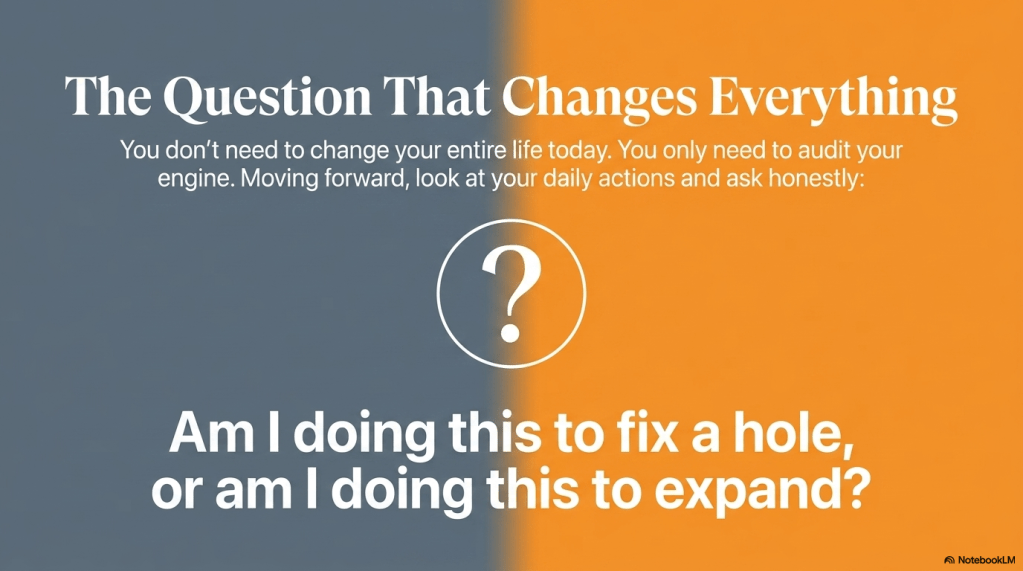
And that question, asked honestly, has a way of changing everything.


Leave a Reply